Preparation without a method
“Clean and prep” gives you no way to compare equipment, removal, edge work, dust control, or the finished surface condition.
Scope before price
Two estimates are comparable only after the work behind them is visible. Decode the preparation, repairs, layers, timing, warranty, and exclusions first. Then evaluate the number.
Published Updated
Quote anatomy
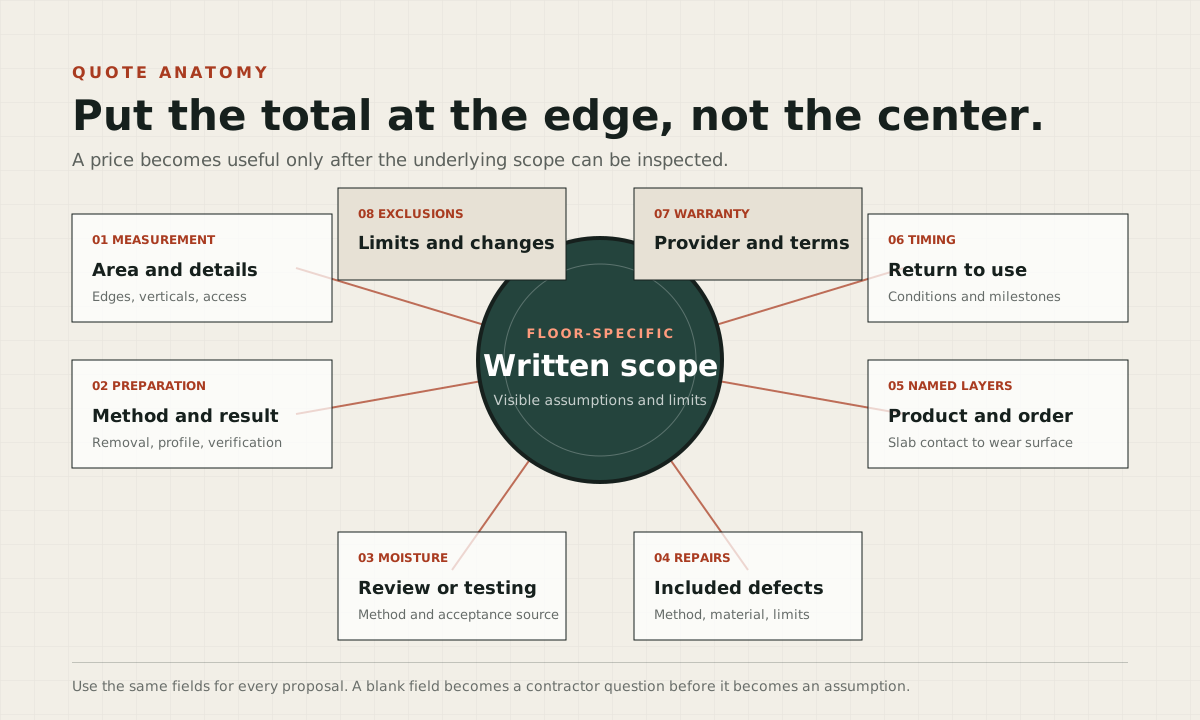
This diagram is illustrative. A real proposal should identify the actual products, sequence, preparation, repairs, conditions, and limits for your floor.
Illustrative decision aid
The total belongs at the edge of the decision, after the scope is visible. Use the fields around the center to find assumptions that need a written answer.
Line-item decoder
A quote can use different wording and still be complete. The test is whether you can identify the work, assumptions, named products, limits, and exact question that closes each gap.
| Quote line | What it means | A complete version | Red flag | Exact question |
|---|---|---|---|---|
| LINE 01Surface preparation method | How the installer plans to remove unsuitable material and create the surface condition required by the named coating system. Reference: ICRI 310.2R (2013). Accessed August 12, 2026. | Names the method, areas included, removal work, edge treatment, dust control, and how the finished surface will be checked against the product instructions. | The scope says only “clean and prep,” with no method or acceptance point. | What preparation method will you use, what should it leave behind, and how will you verify that result? |
| LINE 02Moisture review and testing | How visible signs, water history, slab conditions, and any quantitative testing will be handled before the system is finalized. Reference: ASTM F2170 (2019a), ASTM F1869 (2023). Accessed August 12, 2026. | Names observations or test methods, locations and timing, who performs the work, and which current product limit will be used to interpret the result. | A dry-looking surface is treated as proof that moisture cannot affect the project. | What moisture information do you need, which test applies here, and what product document sets the acceptance limit? |
| LINE 03Crack and spall repair | Which visible defects are included, how they will be prepared, and what future movement remains outside the repair promise. | Identifies included locations, repair materials or method, joint treatment, finish expectations, and exclusions for movement or hidden deterioration. | Repairs are described as “as needed” with no included quantity, locations, or change-order rule. | Which defects are included now, how will you treat them, and what future movement is excluded? |
| LINE 04Named layer system | The manufacturer and product used at each step, from the layer touching concrete to the exposed wear surface. | Lists each named product in order, its role, decorative broadcast if used, and confirmation that the proposed layers form a compatible assembly. | The quote uses “epoxy,” “poly,” or “flake floor” as the entire specification. | What exact product touches the concrete, what are the intermediate layers, and what becomes the wear surface? |
| LINE 05Film thickness and coverage | How a stated thickness or coverage applies to each coat or to the completed system. | Includes units, identifies whether the value applies wet, dry, per coat, or in total, and ties the number to the named product documentation. | A thickness appears without units, layer context, coverage assumptions, or a supporting product document. | Does this thickness apply to one layer or the full system, and where is it stated for the named product? |
| LINE 06Cure and return to use | The written plan for foot traffic, moving belongings, parking vehicles, and protecting the floor while the system develops its intended properties. | Separates milestones by activity, states the jobsite conditions assumed, and points to current instructions for every named product. | The quote promises “ready tomorrow” without defining the activity, conditions, or product source. | When may people, stored items, and vehicles return under the expected slab and room conditions? |
| LINE 07Warranty terms | Who provides the warranty, what work or failure modes it covers, how long it applies, and what can void or limit it. | Supplies written terms, provider identity, exclusions, claim process, transferability, maintenance duties, and any tire or moisture language. | A verbal “lifetime” promise appears without a provider, written coverage, exclusions, or claim process. | May I read the complete warranty, including exclusions and the process for making a claim, before signing? |
| LINE 08Exclusions and change triggers | Work, materials, site conditions, and owner responsibilities that are not part of the quoted scope. | Covers clearing the space, old-material removal, vertical faces, joints, hidden damage, access, utilities, cleanup, taxes, travel, and written change approval. | Important work can be added later with no definition of what triggers a change or who approves it. | What is not included, what discovery could change the scope, and how will I approve a change before work continues? |
Common omissions
“Clean and prep” gives you no way to compare equipment, removal, edge work, dust control, or the finished surface condition.
“Epoxy” is not a layer-by-layer specification. Ask for the manufacturer and product name at every stage.
A number needs units, layer context, coverage assumptions, and a current product document before it becomes comparable.
Provider, coverage, exclusions, maintenance duties, transferability, and the claim process belong in writing.
Visible conditions and water history should not disappear from the scope. If testing is needed, the method and acceptance source should be named.
Foot traffic, stored items, and vehicles are different milestones. Each needs conditions and product-specific guidance.
Use the cluster
The decoder organizes the written scope. The related guides help you decide whether that scope fits the slab, the system choice, and the cost drivers you care about.
Printable worksheet
Use your browser’s Print command. The print layout hides the rest of the site and leaves writing room for two or three proposals. Blank space shows what a proposal leaves unanswered.
Twin Cities Epoxy planning tool
Record what each written proposal actually includes. This worksheet does not replace contractor clarification, product instructions, or a site assessment.
| Scope field | Quote A | Quote B | Quote C |
|---|---|---|---|
| Contractor and quote date | |||
| Measured area and included details | |||
| Surface preparation and verification | |||
| Moisture review or test plan | |||
| Crack, spall, and joint scope | |||
| Named products in layer order | |||
| Thickness and coverage context | |||
| Finish, texture, and sample details | |||
| Foot, storage, and vehicle milestones | |||
| Cleanup and owner responsibilities | |||
| Written warranty terms | |||
| Exclusions and change triggers | |||
| Quoted price and payment terms | |||
| Questions still unanswered |
Planning use only. Confirm unclear or conflicting terms with each contractor in writing before making a decision.
Technical references
Surface-preparation framing follows ICRI 310.2R, edition 2013. Moisture-test names refer to ASTM F2170, edition 2019a and ASTM F1869, edition 2023. Sources accessed August 12, 2026. No threshold on this page clears a floor for coating. The named system’s current instructions and a qualified site assessment control.
Project-specific guidance
Share the slab condition, use, finish direction, access, and timing. We review the request and contact you about next steps without promising contractor availability or a preset system.